Teacher Training: About The Courses

Our Philosophy

We are committed to giving value through conveying practical skills that make a
real difference, both short- and long-term, to the prevention and management of
stress, injury, postural and ergonomic issues.

Tutors

All our teachers are working professionals who contribute to the rich variety of skills that make the course a lively and enthusiastic learning environment. They include:

Head of Training Carolyn Nicholls BA (Hons), MA, MSTAT

Assistant Head of Training Astrid Holm, BA (Hons), MSTAT

Senior Teacher Lord Ritchie of Dundee (“Rupert”) MSTAT

Francesca Aldridge MSTAT

Mark Claireaux MSTAT

Malcolm Balk MSTAT, CANSTAT Running Coach and author of Master the Art of Running

Pete Blackaby (Anatomy)

We have regular visiting teachers from other parts of the country and overseas.

STAT Certification and OCN accreditation

The course is of three years duration and training time is a minimum of 1600 hours over the three years. This is in accordance with the rules of the Society of Teachers of the Alexander Technique (STAT) who have approved the course. Successful graduates are STAT certified, will be issued a certificate of training from the Brighton Alexander Technique College and may undertake the OCN quality assured accreditation course that runs alongside the training course.

The Brighton Alexander Technique College developed this course with The Open College Network and it has been successfully running since 2005. In 2008 Carolyn Nicholls and Jan Mulreany of OCN have redeveloped the course to give an even more exciting programme offering students an opportunity to undertake a research project, learn reflective practice skills and more.

A student comments: I wanted to do the OCN because I wanted to build up resources, which I could draw upon when I began to teach, but was quite vague as to how I would do it. I realised the OCN requirements would provide me with a structure I could use for this purpose – and the additional qualification was a bonus.

When it actually came to doing it, I kept notes of our activities, lectures and observations in class, and used that to fill in the records. If I looked through my notes and record book once or twice a week, I invariably found some observations or activities, which I could use to fill in 3 or 4 entries.

Thinking about what my portfolio should include helped me to organize my material so I could access any information I wanted quickly and easily. Looking at the resources I have available now, I am delighted with the material I have collected together and have already used it to prepare a presentation I am doing to a corporate company.

Padmini Menon

Established Training Course

Since 1990, we have trained people from all over the world, graduating over 50 teachers who now teach in many overseas countries as well as Brighton and all over the UK. Becoming an Alexander Teacher is an exciting journey of gaining professional skills, personal growth and development. Recently one of our graduates has returned to India as the first resident AT teacher in the country.

Click HERE to view the COURSE PROSPECTUS (PDF)

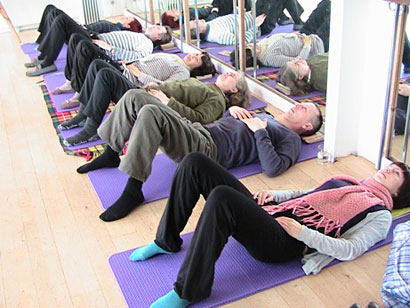
Come in,  lie down,  do nothing

Our training day starts with semi-supine, a practical procedure that encourages deep release of long held tension patterns and reorganization of postural support.

It is an active process although from the outside it looks simple, it is an exploration of Use and Functioning; and it’s a wonderful way to start the learning day.

Access to Training – Your Options

As well as the full time training course we offer modular training based upon blocks of training time.

Option 1 (traditional). Full time training requires you to complete eighteen 5 week blocks of training consecutively over the three years. This is the normal pattern of training.

Option 2 (Modular). Modular training requires you to complete eighteen 5 week blocks of training within a four year framework. This is a more flexible option, which may suit those needing to work whilst training. Please call or email for more details.

To complete training you need to have reached the required level of skill, which is assessed by the Head of Training and external moderation. In addition you need to complete a minimum of 1600 over a minimum of a three years.

We also offer a variety of ways you can get involved with the training course, you can spend a morning a week for half a term or a term, to get regular in-depth Alexander experience, you can study with us for one week, a half term (5 weeks) or even a year.

You will be included in the full college timetable, receive regular work from all the training course teachers, join in with activities, lectures and discussion. You can explore voice work, performance skills, application for musicians, or simply enjoy the work for your own self development and well-being.

The Alexander Technique can be practiced anywhere when you have the skills!

Our Heritage

The Brighton Alexander Technique College is a Carrington style-training course, evolving our practice from the renowned skills of Walter & Dilys Carrington. Carolyn Nicholls, Head of Training, was privileged to have been trained by Walter and Dilys Carrington at the Constructive Teaching Centre in London, qualifying in 1982. Walter ran Alexander’s own training course and took over at Alexander’s death in 1955. He ran a remarkable course, together with Dilys and other teachers up to his own death in 2005. Dilys was a very creative teacher who influenced the development of what is known as ‘hand-on’ skills, the subtle, elastic quality that defines a good Alexander teachers hands.
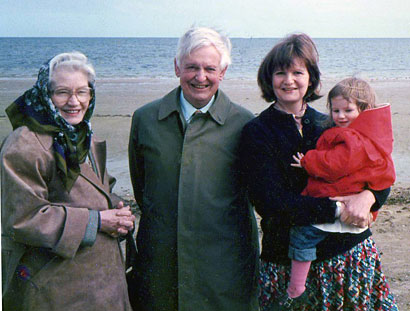
Dilys and Walter Carrington with Carolyn and daughter 
on a beach in St Kilda, Melbourne Australia in 1987

Carolyn documented this approach of Dily’s in 1986, and in 1987, Walter and Dilys visited Australia, where she was the assistant director of The Melbourne Alexander Teacher Training School, to see how her ideas were being put into practice. Carolyn reviewed the document when she undertook a master’s degree in Alexander Technique Teacher training in 2003 (UeL).

Dates & Times

There are 3 terms per year and as far as possible dates coincide with state school term dates. Classes are in the morning, Monday to Thursday each week. Each class starts at 9-00am and ends at 1-30pm, with a short break in the middle.

Contact us for term dates.

Students may start training at the beginning of each half term. The size of the training course is small to ensure that each student receives individual attention. We offer a carefully planned programme of experiential learning so everyone covers all the ground necessary regardless of when they start training.

Curriculum

At the Brighton Alexander Technique College the core curriculum is informed by Carolyn’s Masters research study in the Specialised Use of The Hands in Alexander Technique.

Core curriculum consists of continuous training and practice in improving the trainees own use so that they have a reliably good standard of use and can be expected to go on improving after they have left the training course. Naturally this implies that they are given an understanding of how to go on working on themselves. This involves a developing understanding of the basic concepts of the Technique, both kinaesthetically and intellectually, these include:

• Primary Control

• Inhibition & direction

• Non-endgaining and means-whereby.

• Non-doing.

• Faulty sensory appreciation

• Use and functioning.

• Psychophysical integration

Training in the established procedures of teaching the Technique. These include Chair work, table work, saddle work, walking, breath and voice work, and application to activities.

Chair and table work involve learning to use one’s hands well as a teacher, and this is a fundamental aspect of Alexander teacher training. It needs to be taught under close supervision from experienced teachers, as it is the heart of the whole training.

We deal with this in small groups, usually three or four students together, and we guide them through a step-by-step programme over the first two years of the course. In this programme simple practices become the foundation from which more complex skills can develop. It is a steady, well worked-out discipline, like a musician learning scales, which needs to be established before students become able to work more fluidly as they get towards the end of their training.

Throughout the course classes and exercises are given to develop verbal and written fluency in presenting the Alexander Technique.

Students are expected to work on themselves both during course hours and outside of course hours, and they have access to a substantial library of relevant books and articles.

The first year of the training focuses on the individual students learning to improve their own self-awareness and use. This is an indispensable pre-requisite for teaching improved use to others. Alongside this there is study of basic anatomy and physiology and the written works of F.M. Alexander. A study book is given to each student outlining the aims of the year and how to make the most of training.

The second year focuses more on developing the refined manual skills and physical procedures that have been evolved to pass on the Alexander Technique. Considerable class hours are required to develop in the trainees the acute sensitivity of touch required for this work. Concurrently there is further study of anatomy, physiology and related literature to give the trainees sufficient knowledge to understand the intellectual and scientific concepts underlying their work. A study book is given to each student with the aims of the second year and how to prepare for moderation and on-going study.

The third year focuses on the practical problems of Alexander teaching. The trainees progress from practicing on each other to supervised practice on members of the public. The habits of disciplined selfawareness developed in the first two years are put to the test in this situation, as the trainees must maintain good use in themselves if they are to have the sensitivity required to help a new private student. Development of verbal teaching and presentation skills is also included, and there is continuing study of Core Curriculum, as in the previous years. The third year study book orientates students towards graduation and teaching.

Special days

We like to explore different ways of applying the Alexander Technique to a variety of skills and activities. One example was applying the skills to mark making and painting.

This day culminated in the production of a painting that was chosen as the from cover of the Alexander Journal 2010

Entry Requirements

Personal experience of the Alexander Technique, usually at least thirty lessons. If however this is not possible, for geographical or other reasons, and you wish to be considered for training, please contact us.

Some work experience that suggests ability to communicate with people. There is an interview process with head of training Carolyn Nicholls that consists of prospective candidates visiting the course, and having a private lesson with Carolyn.

There is a normal lesson fee payable but no charge for visiting the course.

Overseas Students

In the case of students applying from overseas, where a visit is impractical, we may ask for a reference from your teacher. In the unusual circumstances where a teacher is not available in your country, please contact us, as it may be possible to offer you a place on a probationary basis.

How to Apply

In the first instance, you should contact the director of training, Carolyn Nicholls, either by telephone 01273 562595, or email, carolyn.nicholls@btinternet.com

Language Skills

The course is taught entirely in English. For their own benefit, students from non- English speaking countries should ensure they have acquired sufficient knowledge of English when they begin training to follow instructions from teachers.

Qualification

The Alexander Technique’s main professional body, the Society of Teachers of the Alexander Technique (STAT founded shortly 1955, approves the course and successful graduates will receive certification by STAT, in addition to certification by The Brighton Alexander Technique College. STAT certification entitles the holder to membership of the society, for an annual fee. Benefits of membership include: Access to the society’s office for information and advice Group professional insurance rates organised by the society Access to Continuing Professional Development (CPD) courses and workshops organised by the society’s CPD committee Listing on a professional membership register available to the public Regular receipt of STATnews and The Alexander Journal (professional publications) Voting rights at the societies’ AGM Membership of the largest professional body of Alexander Technique teachers world-wide

Accreditation

The Open College Network has accredited the course at Level 4 & 5 (HE levels 1 & 2). This is a quality assurance accreditation backed by a consortium of Universities. This accreditation is government backed and will offer credits that can be use as APL for HE courses.

Click Accreditation for full details.

email: carolyn.nicholls@alexander-technique-college.com

or call Carolyn Nicholls on 01273 562595

Come and see us

You are most welcome to spend a morning with us if you are interested in training. There is no charge for the first visit and you will be included in all the college activities for that morning.

email:
carolyn.nicholls@alexander-technique-college.com

or call Carolyn Nicholls on 01273 562595

Premises and environment

The training course runs at The Rox School of Dance and Drama in Hove. This is a delightful, large suite of well-appointed rooms, airy, with wooden floors and a sea view. There are several small shops and cafes nearby and Hove’s Western Road with all its shops is a ten-minute walk away.

Hove is approximately one hour by train from London. The Rox School is directly north of Hove station, approx. 2 minutes walk.

Buses run from Hove station to Brighton Town Centre. Contact us to arrange an appointment or if you’d like to ask for more information.

Click for map

Read what one of our graduates says:

When I joined the training course I had read a bit about the Technique, but, coming from India, I had had no lessons at all, and of course, didn’t have any idea of what a training course should contain.

Fortunately, the course covered all the things I thought I would like to learn and lots more that I hadn’t thought of! I liked the blend of rigour and freedom – we had a daily schedule that we followed so there was a structure to the approach, but we also had time to work with each other, read and browse in the library.

The schedule was never a constraint, if something unexpected and interesting came up we could always go off at a tangent to explore it and come back to the routine later. We had a lot of visitors, either teachers from other schools, or people who wanted to have an experience of the course.

Interacting with them was very fruitful because we got different perspectives to the work that we did. All the teachers on the course are very encouraging and patient, and that really helped, especially in the beginning, when I couldn’t quite make out what was going on.

The training course has been running for years and Carolyn combines the richness of her experience with fresh and innovative ways of teaching. It was very exciting to be taught by a teacher who was intensely involved with the Technique and was constantly discovering new aspects of it herself.

After I graduated, while I was nervous about teaching ‘real’ people, I never really had doubts about my ability to do it.

We had a systematic and thorough preparation for teaching, starting from drawing up lesson plans to learning how to communicate the principles of the Technique clearly to our pupils, and deal with their doubts. We also had regular practical sessions when we learnt to work on pupils and talk to them without losing all sense of our own use.

The time that I spent training at the Brighton Alexander Technique College was a period of intense learning, exploration and discovery; I enjoyed it enormously, and I’m confident that I can handle the challenges that will come my way in my teaching career.”

Janet Jacobs